![Shypple Logo white-1.png]](https://help.shypple.com/hs-fs/hubfs/Shypple%20Logo%20white-1.png?height=23&name=Shypple%20Logo%20white-1.png)
Part A: The 3 golden rules of operations
- The 7-Day rule: Submit all documents at least 7 days before ETA (Estimated Time of Arrival). This gives our Customs team time to spot errors and correct them without stalling the container.
- Data consistency: Ensure that weights, quantities, and values match exactly across all documents (Commercial invoice, Packing List, Bill of Lading / B/L). A discrepancy of even 1 kg can trigger an inspection.
Originals are holy: For preferential documents (Eur.1, Form A) and sanitary certificates, we often need the original or a digitally verifiable version. A simple scan is not always enough.
Part B: The customs cheat sheet (quick reference)
Use this table to quickly check if your file is complete.
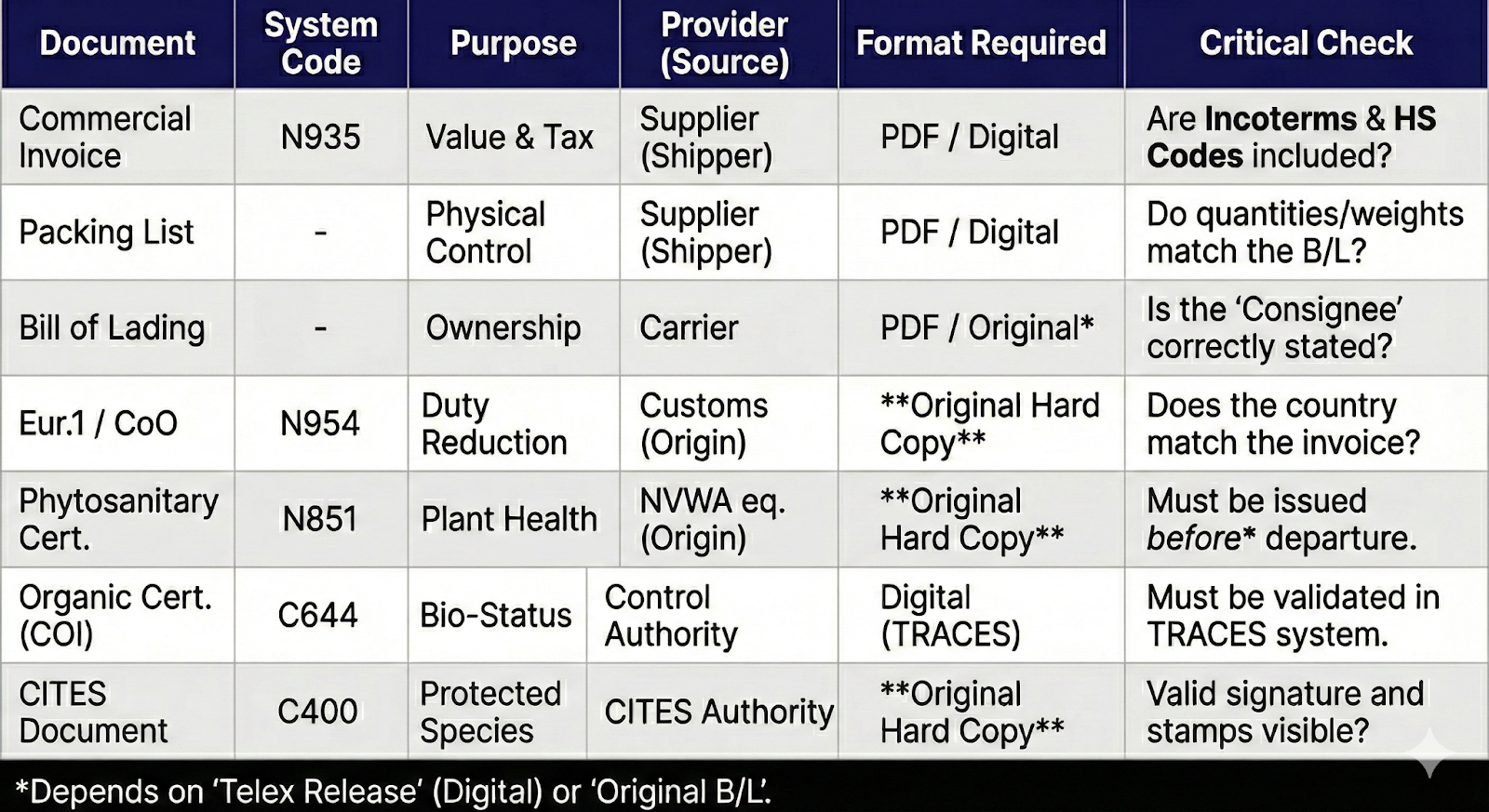
Part C: Detailed document guide
What is the document, why does Customs demand it, and what data is non-negotiable?
1. Commercial invoice (handelsfactuur)
What is it?
The official proof of sale between the seller and the buyer. It is the foundational document for the entire import declaration.
Why do we need it?
Customs uses this primarily for fiscal purposes. They need to determine the Value of Goods to calculate how much Import Duty (invoerrechten) and VAT (BTW) you must pay. Without a correct invoice, tax calculation is impossible.
- Critical data checklist:
- Full description: Detailed enough to classify the HS Code.
- Value & currency: Total amount and currency (USD, EUR, etc.).
- Incoterms: Determines who pays for transport (and if freight costs must be added to customs value).
- Parties: Full name and address of Shipper and Consignee.
Operationscode: Bescheid N935.
2. Packing List (Paklijst)
What is it?
An inventory list that details how the goods are packaged, organized, and weighed.
Why do we need it?
Customs uses this for physical control. If they perform a scan or check, they need to know exactly which box contains which product. For "Dry" cargo, this is essential to verify quantity. For "Fresh" cargo, it verifies net weights for quota checks.
- Critical data checklist:
- Marks & numbers: Corresponding to labels on the boxes/pallets.
- Weights: Gross Weight (including packaging) and Net Weight (product only).
- Breakdown: Detailed content per package.
- Operations note: The total weight on the Packing List must match the Bill of Lading exactly.
3. Proof of Origin (Oorsprongsdocumenten)
What is it?
Documents like the Certificate of Origin (CoO) or EUR.1.
Why do we need it?
To save money. The EU has trade agreements with many countries. If you can prove your goods originated there, you often get a reduction (preference) or full exemption on import duties.
- Types & codes:
- Certificate of Origin: General proof of where goods were made (N954).
- Invoice declaration: A specific legal statement typed on the invoice itself (N864).
4. Special certificates (product specific)
What is it?
Health and safety passports for specific types of goods, mainly food, plants, and organics.
Why do we need it?
Safety & compliance. These documents prove the goods are safe for human consumption or do not carry harmful diseases/pests.
- The big 3 for fresh & bio:
- Phytosanitary Certificate (N851): Mandatory for most fresh produce. Proves the shipment is pest-free.
- Organic Certificate (COI) / (C644): Mandatory to sell goods as "Organic" in the EU. Must be validated in TRACES.
- CITES Document (C400): Only for protected species.
5. Transport document (Bill of Lading / CMR)
What is it?
The contract of carriage between the shipper and the carrier.
Why do we need it?
It proves ownership and the route. customs needs to know the Origin to apply safety regulations and ensure goods are legally allowed to enter the EU.
- Critical data checklist:
- Date of shipment: Determines the exchange rate used for tax calculation.
- Port of loading & discharge: Route verification.
Container number: The unique ID of the unit.